Monday, March 14, 2016

Nepal's trade with the US increased by 0.17% in 2015

US imported about US$ 86.4 million worth of goods from Nepal in 2015, according to US Census Bureau (https://www.census.gov/foreign-trade/balance/c5360.html). Total exports from the US for the same period was US $36.5 million. With a total of US$ 123.1 million compared to US$ 122.9 million in 2014, total amount of US-Nepal trades increased by 0.17%. With this, Nepal now ranks 159th among the top trading partners of the US. In 2014, Nepal ranked 163rd and in 2013 it ranked 164th. As these numbers show, overall trade is improving but in a very small level.

With enforcement of the the Trade Facilitation and Trade Enforcement Act (TFTEA) recently signed by the President Obama next month, Nepal's trade with the US is expected to improve this year onward provided that the political and macro economic situation remain under control in Nepal. In 2015, carpets and textile floor coverings made the biggest share of Nepal's exports to the US (Table 1). With the TFTEA in action, the opportunity to improving the trade of such products with the US has opened up, one more time.

Table 1. Total 10 imports to US from Nepal, 2015
Rank
Commodity
Total 
1
Carpets, other textile floor coverings, knotted
$31,110,177
2
Carpets & Other Text Floor Cover, Woven
$6,327,023
3
Antiques
$5,731,358
4
Shawls, Scarves, Mufflers, Mantillas, Veils E 6214
$3,009,605
5
Preparations for animal feeding
$2,951,607
6
Travel goods, including handbags, wallets, jewelry
$2,225,655
7
Women's or girls' overcoats, knit or crochet
$2,117,947
8
Misc. articles made from textile materials
$1,834,792
9
Hats, headgear, knit, lace
$1,754,664
10
Men's or boys' suits, not knit
$1,555,168
Source: http://ustradenumbers.com/countries/nepal/

We will be closely monitoring and reporting the trade numbers to continuously gauge the effect of the TFTEA and overall trade situations between the two countries. Its an important that Nepal uses this new opportunity to expand the locally made products to the US markets, and builds a foundation of a robust global-local economy.

Thursday, February 25, 2016

Great news for the Nepalese garment industry: USA's Nepal Trade Preferential Act, 2016

There is a very welcoming news for the Nepalese garment industry this week: thanks to the US senator US Senator Dianne Feinstein, who introduced the Nepal Trade Preferential Act in the congress, and President Obama who signed it today. The bill, which has now become a legislation with the president's signature, authorizes duty-free tariff benefits for up to 66 types of items, including certain carpets, headgear, shawls, scarves, and travel goods made in Nepal. This legislation will remain valid for next 10 years. It aims to boost the Nepalese textile and apparel industry which has been severely impacted since 2005 when the global garment quota was eliminated. There are some specifics in the legislation which are targeted to promote the textile, garments, and carpet products made in Nepal utilizing local traditions and cultures:
  1. The legislation covered products should not be import-sensitive (i.e., should not be competitive to other similar types of import products in the US). Also, 35% of these products value must be derived from Nepal, in that it can't be just shipped via Nepal. 
  2. The textiles and apparel products should be assembled in Nepal. These products can be hand loomed, handmade, folklore articles and ethnic printed fabrics;
  3. Nepalese industry should be mindful that there is a limit in the total quantity of exports. The total volume of duty-free imports should not be 1.5% of total U.S. textile and apparel imports.

More analysis on this topic will be forthcoming in this blog. To know more about the legislation, please visit:
  1. http://nepal.usembassy.gov/pr-02-25-2016.html
  2. http://www.feinstein.senate.gov/public/index.cfm/files/serve/?File_id=7ade3fba-fdd1-44a7-8157-6b658b15110e
  3. http://www.feinstein.senate.gov/public/index.cfm/textonly/press-releases?ID=8B3656CA-DBF2-4EE8-BDC6-329B31CCBD9B

Sunday, February 21, 2016

Exports trend of Nepal, India, China and USA from 2006-2015/2016

This post presents trends of total exports of Nepal and its two bordering countries- India and China between 2006 and 2015. Export trend of USA for the same period is also included at the bottom just for a quick comparison purpose. Graph source: http://www.tradingeconomics.com/united-states/exports. 

These graphs speak for themselves. The exports trend line for Nepal is more flat than it is for India, China and USA. The data for Nepal are less up to date. Nepal's exports volume is too small (presented in Nepali Rupees), relative to other countries which are presented in US dollars. 

It should be noted that India, China and USA are not strictly comparable to Nepal in many respects- size of the country, geography, populations, etc. Neither the attempt here is to strictly compare the export numbers of these countries. Instead, the goal is to have a quick visual observation how Nepal's exports look like vis-a-vis other countries in the last 10 years. 

Nepal's total exports may not ever be at part of China and India due to country's size and economic potentials. However, the exports most certainly need to grow more robustly in coming years to lift the country from economic destitutions. 


Tuesday, January 19, 2016

Nepal-US Trade: One of the Weakest in South Asia


US-Nepal trade is weakest among the major South Asian economies.  Although the US exports less to Nepal than it imports, the overall trade is still minimal. The only country in South Asia where US exports less compared to its imports, before Nepal, is Afghanistan. That is likely due to post war and low demand situation there. India is the highest exporter to the US followed by Bangladesh, Sri Lanka, Pakistan and Nepal (see Figure 1).


The trading gap between the US and the South Asian countries was not huge in 1992. Although India was still the biggest net exporter even then, Bangladesh and Sri Lanka were similar in trading with the US. Nepal, Pakistan and Afghanistan were not too different from each other. Fast forward in 2015, the net imports by the US from India sky rocketed, reaching a total net import of US $20,000 million in 2015 from US $1,800 million in 1992, Bangladesh US $4,500 (US $600 million in 1992), Sri Lanka US $2,100 (US $600 million in 1992) and Pakistan $1,500 million (US $ -62 million in 1992) respectively (Figure 1).

Interestingly, the overall trend of Nepal-US trade hasn’t changed much since 1992. The net US import slightly declined in 2015 (US $62 million in 1992, US $41 million in 2015). While the decline in Nepal's exports to the US is not good in itself, Figure 1 puts the US-Nepal trade into a perspective. Nepal’s trade with US today is very similar to what it was back in 1992, while its neighboring countries have moved on. Greater exports to the US- the world’s greatest economy- can indicate many things for a developing country like Nepal—improved trade relations, better flow of goods and services between the countries, improved markets and efficiencies, and countries’ mutual political reach and influence. All major South Asian countries, except Nepal, seem to be moving in that direction. In contrast, Nepal’s trade is increasingly concentrated to India instead. In 1990, the total share of Nepal’s trade with India was only 34%. In 2015, that percentage grew almost double and reached 64%.

Nepal is rich in nature and culture. The arts and antique products and carpets have found consumers in the US market to some extent. Nonetheless, the trade of these products is still very minimal. According to the Office of the United States Trade Representative’s 2013 data, Nepal was 125th largest supplier of goods to the US. The key items exported to US include textile floor coverings, woven apparel, arts and antiques, knit apparel and leather. There is a market in the US, but that market needs to be studied well and Nepalese products should be specialized to meet the need of the market. Harnessing the richest market in the planet and reducing excessive dependency on one market (India) can be beneficial for Nepalese economy in the long run.


Saturday, November 15, 2014

How to make our neighborhoods and cities less air polluted and livable?

There are four immediate causes of air pollution in the cities:
1.      Industrial emissions
2.     Vehicular emissions
3.     Dust
4.     Litter/garbage

Industrial emissions are the result of manufacturing industries such as cement and brick factories. At the moment, industrial emissions are important but not the major air pollutants in Nepal--thanks to the poor state of industrialization.

Vehicular emissions are the number one source of air pollution in Kathmandu and Nepal in general. Blame the old and poorly maintained vehicles coupled with poor and congested roads, bad traffic, and poor fuel quality. On top of this, lack of effective emission control creates a perfect environment for the diesel and petrol guzzlers to exhaust the fumes that’s no good to the people and the environment.

Dust is probably the second biggest air pollutant in Nepal. The unique mixture of vehicular emissions and dust is the reason why you, your clothes and your shoe look so different when you get home even after a brief walk in Kathmandu.

The unmanaged garbage or litter also contributes to air pollution, but it is not as big of a culprit compared to the other three mentioned above. More than the air, littering negatively affects drinking water sources.  

Because vehicular emissions and dust are the major causes of air pollution in Nepal, below I present few good practice examples from the U.S. that can be helpful in addressing the problem.
  • Vehicle emission test: US started to test vehicle emissions in 1960s with growing air pollution in major cities. Established through the US Clean Air Act 1970 and several amendments thereafter, the law and the system have matured over time and they are strictly enforced now. It is required to be done in every two years, and a vehicle must pass various criteria established by the Act. The testing procedure, which uses a computerized system, is so efficient that it only takes about 10-15 minutes to complete the test.
  • Cover up the ground dirt: Nearly every street, road, sidewalk, driveway, runway, parking lot are paved with concrete, asphalt or bricks. Open area in the parks, roadsides, backyard or front yard of a house are generally covered with grass (Picture- grass carpets being placed on the roadsides). 
    Similarly, the bases of the trees and the gardens are covered with something called mulch—made with wooden pallets. The mulch helps keep the moisture while covering the soil. Because the soil is covered nearly everywhere, especially in areas where human footprints are high, the soil dust cannot take off the ground.  And if there is a significant amount of mud or open soil in the residential area for whatever reasons, authorities take no time to clean up. 
  • Anti-littering law and social norm: Littering in public place is illegal in all 50 states in the U.S. One could be fined and/or asked to serve anti-pollution community activities for illegal littering. Moreover, it is something that is socially unacceptable. These legal and social norms are well complemented by the towns and municipalities by abundantly placing the trashcans in every nooks and corners of the cities. The cleaning authorities regularly pick up trashes, and no, there are no strikes or bandh here!
While it may not be possible to adopt all these practices as-they-are in Nepal overnight, authorities there can learn a lot from these examples as they continue to work in making the cities livable.

Saturday, November 8, 2014

Mission Cleanliness: Sharing Few Good Practices

Cleanliness is not only a public health matter; it’s a reflection of a civilized society.  How a community or a country becomes clean is a complex and usually a lengthy phenomenon. It requires a combined intervention of public health policies and change in social or cultural behaviors- both are often mutually inclusive.

Most of the developed countries were plagued with diseases, war and poverty before they were able to realize the importance of personal hygiene, sanitation and cleanliness. With such realization came changed individual behavior, social norms, and public policies, all of which contributed to build clean and healthy societies in those countries. This is not to say that all communities, cities and villages of the developed countries are clean, as it depends on various factors; but on average they are clean.

Developing countries these days don’t have to go through such undesirable events like diseases and war calamities to adopt clean practices. They have an easy access to a zillion of low cost or no cost good practice examples from around the world both in policy design and enforcement, and social behavior and normative change that can be easily adapted into local context. All it is needed is a collective passion for change and a vision, and political willingness. There are several good practices to follow even in complicated aspects like political willingness. Indian Prime minister Narendra Modi’s Clean India Campaign is just one recent example.

In this blog, I have captured few pictures of my current hometown in USA to exemplify a couple of good practices that I believe are helping to make my community look clean. The first picture shows few metal signboards stuck in the ground. These signboards are to advertise new houses that are on sale in the area, and they can be easily pulled off from the ground when they are not needed. They haven’t created visual pollution, and the materials used can be recycled.

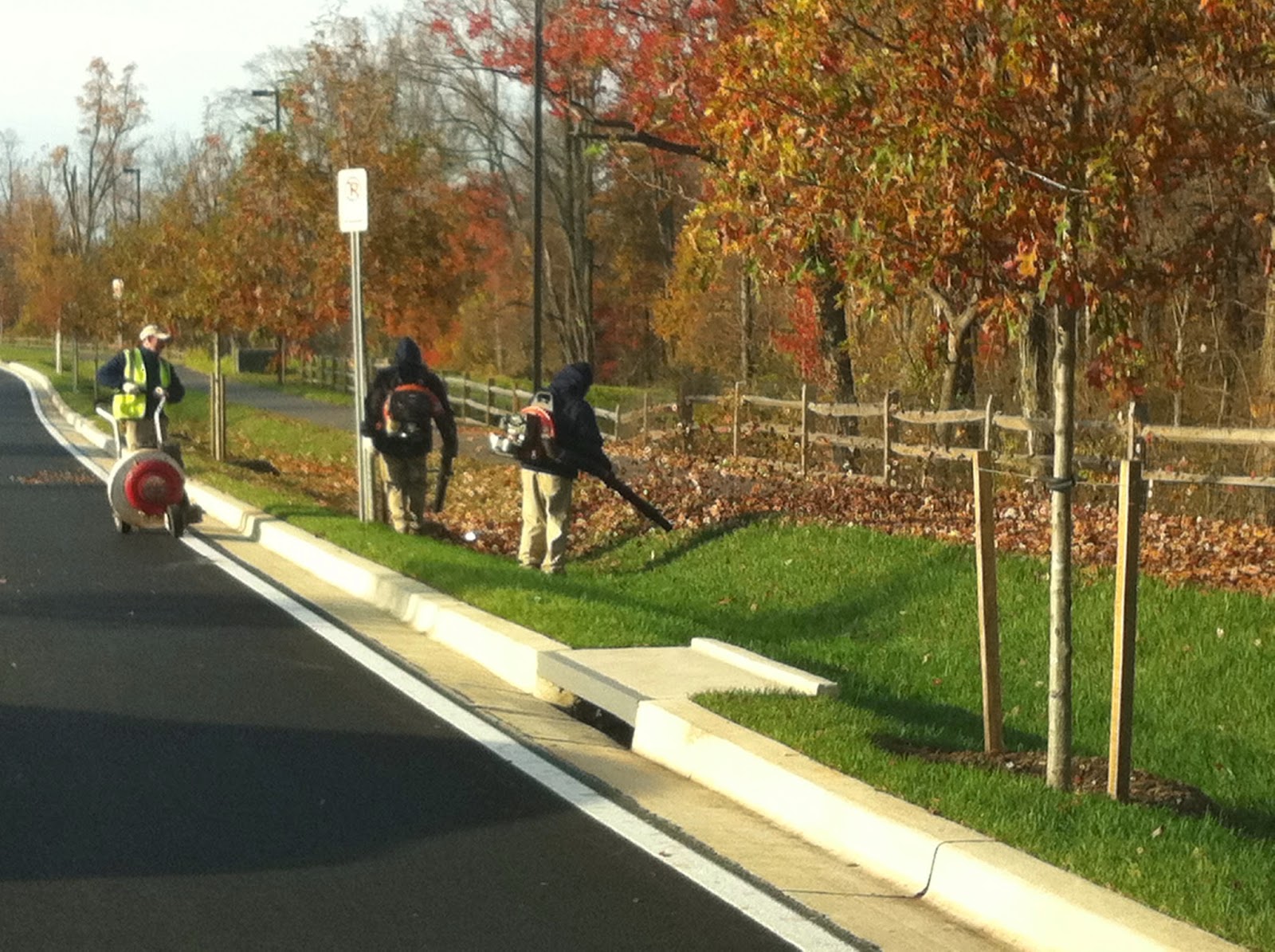
The second picture shows a few workers hired by our Homeowner’s Association to help clean the community we live in. A Homeowners Association is a community body established to monitor and enforce the rules created by the association. It maintains the economic and social value of the community. As apparent in the pictures, the workers are using simple technology—the portable air blowers-- to clean the dead leaves off the ground alongside the street. These air-blowers clean dust, dead leaves and other light trashes off the ground without having the workers use labor-intensive tools such as brooms.

Practices and technologies like these can be easily adapted in developing countries. I said adapted, not replicated, because we know that most developing societies are constrained in basic fundamentals of development such as electricity, water etc. So instead of conventional energy, solar-energy-fueled air-blower can be developed. Instead of perfectly shaped and painted metal signboards, hand-painted signboards can be used in an organized fashion. The point is that simple ideas like these can greatly help reduce and manage unnecessary trash, and help maintain the aesthetic view of the communities. By aesthetic, I didn’t mean to treat this topic as something that’s not as critical for wellbeing. To me, it is a development vision that I see on things, which in this case is my neighborhood. I truly believe that everyone deserves to live in a reality of such a vision.


Sunday, August 10, 2014

Are we prepared against Ebola?

Nearly 932 people have already died in West Africa since the Ebola outbreak about six months ago. As of now, four countries in particular- Liberia, Sierra Leone, Guinea, and Nigeria- have been hit hard by the virus, and a some citizens of USA, Saudi Arabia, and Spain are also inflicted (International Business Times). There is no reason to believe that the virus won’t travel to South Asia and Nepal eventually.

According to WHO, Ebola transmits through close contact with the blood or other bodily fluids. It is believed to have inflicted human via infected animals (monkeys, chimpanzees etc.). Ebola has the case fatality rate of 90%. Initial symptoms of the disease are fever, weakness, headache followed by diarrhea, vomiting, etc. eventually leading to liver and kidney failure. Someone infected with Ebola virus may take 2-21 days to show up the symptoms (WHO).

Times of India recently reported that there are nearly 45,000 Indians living in Ebola affected countries (Times of India). If the virus outbreak persists and increases further, many of them may return back to India. Already a certain number of Indians working in Liberia are planning to return back to India. As such Indian government has planned various precautionary measures such as airport screening, self-disclosure upon arrival, airport health facilities in the key airports where people from Africa likely come in.

Small number of Nepalese are currently living in the Ebola affected countries in West Africa mainly for the UN peace-keeping work. So far there is no record of any Nepali citizen being affected by the virus (The Himalayan Times). As much as this is a good news, it is equally important for the government to be prepared in case if the unexpected happens. Beside, given a large number of Indian populations living in West Africa, and their frequent travel between India and African countries, the possibility of Ebola coming to India and subsequently to Nepal cannot be avoided altogether.


It is a high time that the Ministry of Health (MoH) alerts all of its health systems to pay especial attention to any potential Ebola outbreak. Arrangements also need to be made at the airport and other immigration points to monitor health of the foreigners and Nepalese entering to Nepal, particularly those coming from Africa. But most of all, MoH should proactively initiate discussions on Ebola prevention and control with other relevant line ministries and departments as appropriate, and swiftly develop an appropriate strategy and implement it in order to systematically deal with the potential outbreak of the virus in Nepal.